The Automation Paradox in B2B Email
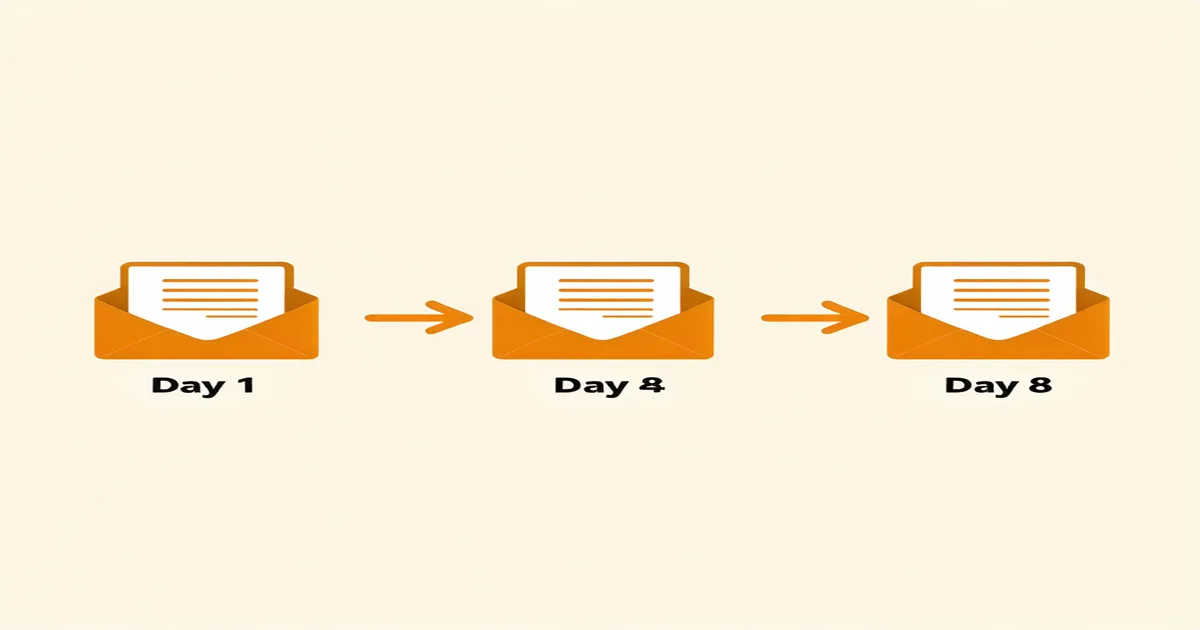
The setup for most B2B nurture sequences is technically sound: a marketing automation platform, a defined enrollment trigger, a sequence of six to eight emails spaced three to seven days apart. What often isn't sound is the writing. Not because the copywriter is weak, but because the emails are written to the sequence rather than to the reader.
Writing to the sequence means thinking about the logic of the drip campaign: email one introduces the company, email two delivers value, email three follows up with social proof, email four asks for the demo. Writing to the reader means thinking about what a specific type of buyer — at a specific point in their consideration cycle, enrolled because of a specific trigger — actually needs to receive to take the next meaningful step.
The problem is structural. Most nurture sequences are written once, at the campaign planning stage, by someone optimizing for the email-to-email logic rather than for what the recipient experiences across all six. From the recipient's side, what reads as a coherent campaign logic from the inside reads as "here is a series of messages this company is trying to send me." The automation is invisible until it's obviously automation, and then it's permanently automation.
The Enrollment Trigger Is the Whole Brief
Every nurture sequence has an enrollment trigger: downloaded a white paper, attended a webinar, visited the pricing page three times, submitted a contact form. The trigger tells you almost everything you need to know about what the reader's mental state is and what the sequence should be doing.
A prospect who downloaded a white paper on content ops audit frameworks is in a diagnostic mindset. They've identified a potential gap in their process and are looking for frameworks to evaluate it. A nurture sequence for that prospect should continue the diagnostic conversation: more frameworks, more specific problem analysis, content that helps them understand what they're dealing with before asking them to talk to sales.
A prospect who visited the pricing page multiple times is in a different mental state entirely: they've already decided there's a problem, they know roughly what kind of solution they need, and they're trying to make a financial case. Sending that person the diagnostic framework sequence is a mismatch. They don't need to be convinced the problem exists. They need pricing context, ROI framing, and a clear next step.
The failure mode here is using one sequence template for all enrollment triggers. The automation mechanics differ; the writing often doesn't. Before writing a single email, articulate in one sentence what the enrollment trigger tells you about where this reader is in their thinking and what they need next. That sentence is the brief for the entire sequence.
Writing the Individual Email
A B2B nurture email that doesn't feel automated has three characteristics that are worth examining at the copy level.
It opens with something the reader will recognize as specific to them. Not "As a marketing leader, you know that..." — that's generic. Specific means referencing the context of the enrollment, the industry, the problem type. "If you downloaded our content ops audit framework, you're probably in one of two situations..." is specific. The reader knows immediately that what follows was written for their context, not every person on the marketing list.
It delivers something before it asks for anything. The ratio of value to ask varies by position in the sequence, but the early emails in any nurture series should have a very low ask-to-value ratio. A short, genuinely useful piece of analysis. A framework the reader can apply in 20 minutes. A specific question that will help them think through the problem more clearly. The automation detectors in a B2B buyer's brain fire when emails feel like they're extracting engagement, not providing it.
It has a single, specific, clear next step. Not "let us know if you have any questions" — an invitation with no clear target action. Not two or three CTAs competing for attention. One next step: read this piece, download this template, book this call. If the email has multiple CTAs because the team can't agree on a single conversion goal for this email in this sequence, that's a campaign design problem, not a writing problem. Resolve it before writing.
Sequence Length and Timing
The industry-generic recommendation — six to eight emails over four to six weeks — is a starting point, not a rule. The right sequence length depends on the complexity of the purchase decision and the typical evaluation timeline for your ICP.
A growing B2B SaaS with a self-serve, low-friction purchase might run a three-to-four email sequence over two weeks: the buyer's evaluation cycle is short, and a longer nurture sequence just gives them more opportunities to unsubscribe before converting. An enterprise software sale with a six-month evaluation cycle and multiple stakeholders needs a longer, slower sequence that covers different buyer roles over time.
Timing is also context-dependent. Three days between emails is aggressive for enterprise buyers who receive 150 emails daily and need time to act on each one. Seven days may be too slow for a buyer who just had a triggering event and is actively evaluating. The most honest answer is: look at your open and click data, find the gap between the last email with normal engagement and the first email with sharply declining engagement, and set your cadence accordingly for each segment.
Where Personalization Actually Pays Off
There's a spectrum of personalization in nurture email, and the returns are not evenly distributed across it. First-name personalization is table stakes and doesn't register as personalization anymore. Company name in the subject line was powerful in 2015 and is now recognized as a variable injection.
What still reads as personal — and earns the response rate premium that motivates all the personalization effort — is industry or role specificity that changes the argument of the email, not just the salutation. An email that opens with "for teams in financial services, the compliance angle on this is different..." or "if you're the only content person at your company, you're probably managing this without the infrastructure that larger teams rely on..." makes the reader feel seen in a way that first-name variables don't.
We are not saying that basic personalization tokens add no value — they do, at the margin. We are saying that allocating the majority of the personalization effort to argument-level segmentation produces significantly better results than spending it on variable injection. Segment the sequence by enrollment trigger and ICP profile. Write slightly different versions of the key emails for each segment. The lift justifies the effort in most B2B programs generating more than 200 MQLs per month.
The Re-Engagement Sequence as a Diagnostic
At some point, a portion of every nurture list goes cold: the emails get opened but not clicked, or stopped getting opened entirely. The default response is to run a re-engagement sequence with a subject line designed to get an open — "Did we lose you?" or "One last thing." These sequences generate some response, but they're primarily asking the reader to recommit to a conversation they've already deprioritized.
A more useful frame: treat a cold nurture cohort as a diagnostic signal. If a large percentage of a specific segment goes cold at the same email in the sequence, the problem is probably the email — not the audience. If drop-off is distributed across the sequence, the problem is more likely the enrollment trigger: these prospects were enrolled before they were ready to engage. If the pattern is consistent across triggers and segments, the sequence itself may be solving for the wrong problem.
Re-engagement sequences have their place. But before writing one, check the data on where engagement actually broke down. The fix may not be a new re-engagement email — it may be restructuring the fourth email in the primary sequence, which is where the drop-off shows up across three different segments.