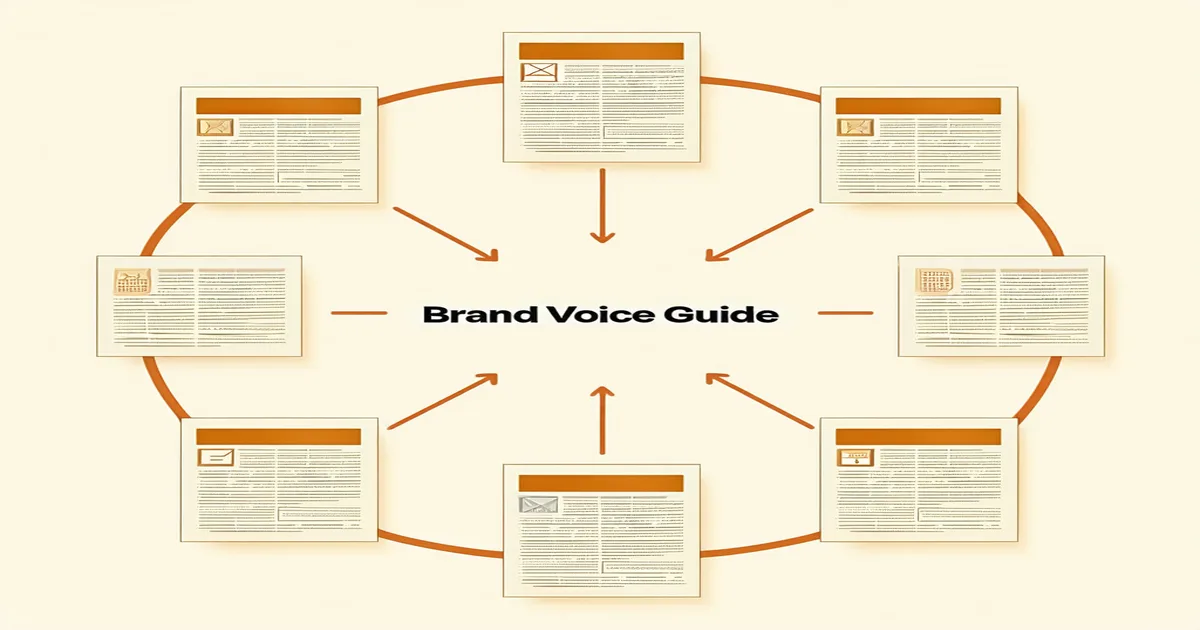
Voice Drift Is a Systems Problem, Not a Talent Problem
When you have one writer, brand voice is a personality. When you have four writers, two freelancers, an agency partner, and a demand-gen manager who sometimes writes LinkedIn posts, brand voice is a coordination problem. The mistake most teams make is trying to solve it by hiring better or editing harder. The actual fix is building the system that makes consistent voice the path of least resistance, regardless of who's doing the writing.
Voice drift — the gradual divergence of tone, vocabulary, formality, and editorial stance across content assets — is one of the harder problems to quantify, which is why it tends to get treated as aesthetic rather than operational. But in B2B marketing, where the content program is building credibility with skeptical buyers over months, voice inconsistency has a real cost: it makes the brand feel assembled by committee rather than authored with intention. Buyers notice, even when they can't articulate what's off.
What a Brand Voice Guide Actually Needs to Contain
Most brand voice guides contain three things: a list of adjectives ("bold, conversational, precise"), a few dos and don'ts, and a sample sentence or two. That's a brand mood board, not an operational voice guide. A writer who reads it understands the vibe but has no way to apply it to a specific brief.
A voice guide that actually produces consistent output needs to work at four levels:
Tone spectrum and context rules. Voice isn't monolithic across all content types. A brand can be "direct and analytical" in thought leadership articles while being "warmer and more approachable" in onboarding emails. The voice guide should define the tone range and specify which register applies to which content format. If the guide doesn't account for format variation, writers will average it and produce content that doesn't fit any context well.
Vocabulary and phrasing constraints. The most actionable voice guidance is specific phrase-level: words and constructions the brand uses, words and constructions it avoids. Not "use plain language" — "avoid passive voice constructions in headings, avoid turning verbs into noun phrases ('facilitate the achievement of' vs 'achieve'), avoid 'leverage' as a verb." The more specific, the more directly applicable.
Structural defaults by content type. Does the brand open articles with a problem statement or with a counterintuitive claim? Does it use subheadings as full sentences or as category labels? Does it end with a recommendation or with an open question? These structural defaults are voice at the architectural level — they create consistency that a reader recognizes even without reading the words.
Annotated examples. The highest-value section of any voice guide is a set of before-and-after examples that show the voice guide applied to actual content: a sentence rewritten from generic to on-brand, a paragraph restructured to reflect the preferred format, a headline transformed from bland to specific. Examples are more instructive than any description.
Voice-Locking vs. Voice-Suggesting
The difference between a voice guide that works and one that doesn't is whether it's treated as a constraint or a suggestion. A suggestion gets consulted when there's time and ignored when there isn't. A constraint is the minimum standard every output is checked against before it's approved.
For an in-house team, this distinction plays out in the review workflow. If the editor's job is to check for factual accuracy and structural quality but voice consistency is not an explicit review criterion, voice drift happens at exactly the moments when the content load is highest — when there's no bandwidth to care about whether the latest blog post sounds like the brand. Building voice review into the editorial checklist, even as a five-minute scan against the guide, closes most of that gap.
For external writers and agencies, the constraint needs to be embedded in the brief. A brief that includes two or three sentence-level voice examples — this is how we'd phrase this, this is what we'd avoid — gives a freelancer more actionable direction than a five-page voice guide they'll read once and half-remember. The brief is where voice direction gets operationalized, not the guide itself.
The Multi-Format Consistency Problem
Voice inconsistency is easiest to spot within a single format — blog posts that sound different week over week. It's harder to catch, and more damaging, across formats: the formal analytical tone in the white paper is completely disconnected from the casual chatty tone in the email nurture sequence, which is disconnected from the corporate-speak in the case studies. A buyer who touches all three in the same evaluation cycle is receiving signals from what feels like three different brands.
We are not saying all formats need to sound identical — they shouldn't. We are saying that a buyer should be able to recognize the same editorial sensibility across the email, the case study, and the article, even if the register varies. The through-line is the perspective and the values: the brand's characteristic way of thinking about problems, not just its characteristic word choices.
Getting cross-format consistency right requires the voice guide to address format variation explicitly, and requires someone in the editorial process who has read enough content across formats to spot when the through-line breaks. In most teams, that's the content lead or head of content — and it only works if they're reviewing content across all formats, not just the ones they personally produce.
Scaling Voice With Freelancer and Agency Networks
The hardest voice consistency challenge in B2B content is scaling output through external writers without losing the voice. It's tempting to solve this by hiring fewer but more senior freelancers who can internalize voice more deeply. That helps, but it doesn't scale indefinitely.
What scales is a brief structure that carries enough voice information to constrain the writer's choices at the most critical decision points. Every brief sent to an external writer should include: the voice guide summary (condensed to one page), two or three recent on-brand pieces as style references, and at least one example sentence or paragraph showing the preferred treatment of the specific topic or argument in the piece. Writers don't fail at voice because they lack skill — they fail because they don't have enough contextual signal to infer what "on-brand" means for this specific piece.
As the volume grows, a systematic review mechanism matters more than individual editorial judgment. A simple voice scorecard — five criteria, each rated on a three-point scale — applied consistently to every third or fourth piece from each external writer gives the content lead actionable data on where drift is happening before it becomes a pattern. It also gives the writer specific, documentable feedback rather than the vague "this doesn't sound like us" that most freelancers have heard too many times and can't act on.