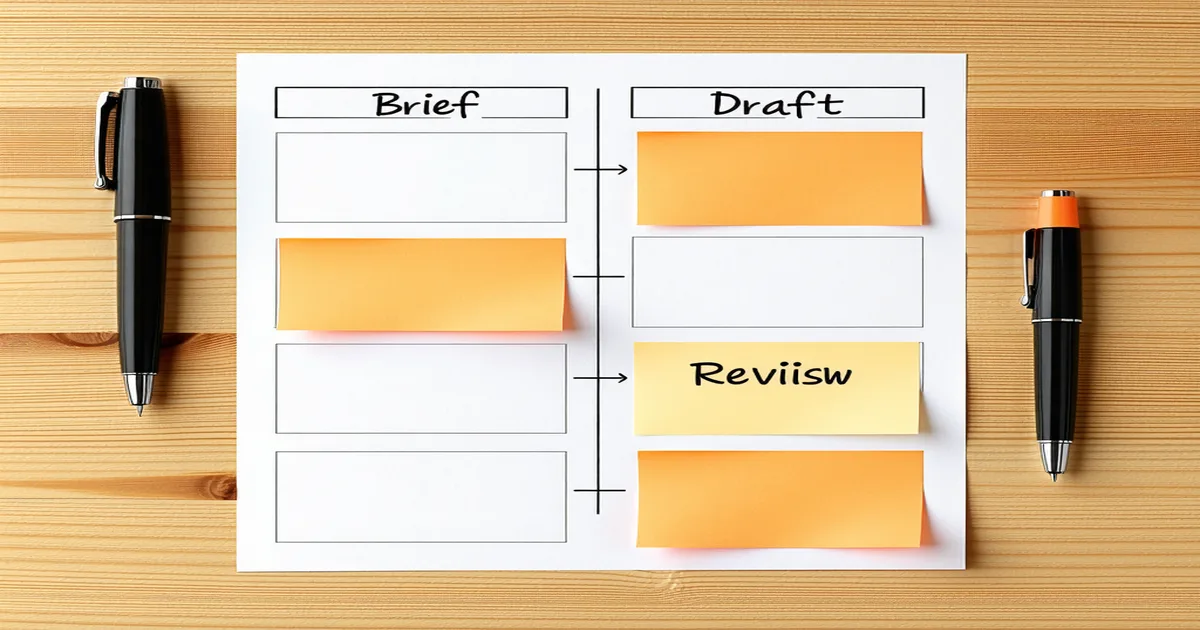
The Workflow That Lives in One Person's Head
At some point in the life of every B2B marketing team, the content workflow becomes tribal knowledge. The content manager knows how to commission a piece, who the good writers are, where the brief template lives, what the approval steps look like, who needs to sign off before publish, and how the piece gets into the CMS. Nobody else does. It works until that content manager takes parental leave, changes jobs, or gets pulled onto another project at the same time the team is trying to ramp output.
This is not a talent problem. It's a documentation problem. The workflow itself may be perfectly calibrated — the right stages, the right handoffs, the right quality gates. The problem is that it only exists as a model in one person's mind, and that model is not portable.
Documenting the brief-to-publish workflow is, in most teams, a half-day project. The reason it doesn't happen is that it doesn't feel urgent until the moment it becomes critical — and by then, the team is already losing time rebuilding it from scratch.
Mapping the Six Stages
The brief-to-publish workflow varies by team size, content type, and organization, but the core stages are consistent. The documentation task is to make every decision point explicit: who decides, what the criteria are, and what "done" looks like at each stage.
Stage 1: Content calendar and brief intake
The piece gets onto the calendar. A brief gets written. This stage has two decision points that usually lack clarity in undocumented workflows: who decides what goes on the calendar (content lead? marketing manager? product marketing?) and what the minimum viable brief looks like before the piece can move to production. If the brief can be sent with three fields filled in and nine fields blank, that's a standards problem that will show up at Stage 4 as a revision problem.
Stage 2: Brief review and alignment
The brief gets reviewed by at least one person who is not the brief author — ideally someone with product context, customer context, or competitive context that the content manager may lack. This stage exists to catch the brief-level mistakes that produce revision cycles: ICP mismatch, wrong funnel stage, an argument the market won't buy, a claim that product marketing will reject on accuracy review. Most teams skip this stage because it looks like overhead. The teams that have it skip two revision rounds per piece and produce more accurate first drafts.
Stage 3: Writer assignment and onboarding
The brief goes to a writer. For recurring writers who know the brand, this is straightforward. For new writers or pieces requiring domain expertise outside the regular bench, this stage needs clarity: how is the writer selected, what context do they receive beyond the brief, and is there a brief alignment call before writing starts? The alignment call is a 15-minute investment that prevents the "writer misread the brief" revision cycle from running twice.
Stage 4: Draft review
The first draft comes back. This is the stage with the highest variation in how teams handle it, and the most common source of inefficiency. Is there a clear rubric for what a first draft needs to meet to pass review? Is the reviewer checking against the brief, or against a general sense of quality? Are there multiple reviewers whose feedback can conflict, and is there a process for resolving conflict before it goes back to the writer?
In undocumented workflows, draft review is often the stage that stretches into multiple unplanned rounds. In documented workflows, the review criteria are specified in the brief, the reviewer has a checklist, and the feedback goes to the writer in a single consolidated pass. The writer knows what "needs another pass" means and what "approved with light edits" means. Ambiguity in this stage costs days per piece at any meaningful content volume.
Stage 5: Final approval and legal/compliance review
For most B2B content, this is lightweight — a final read by the content lead, occasionally a look from product marketing to catch any product claims that need updating. For regulated industries — fintech, healthcare, legal — this stage can involve compliance review that adds time, and it needs to be scoped into the production timeline, not discovered at the end.
The documentation question here: who has final publish authority, what do they need to sign off on, and what's the turnaround expectation? "Waiting on legal" as an indefinite hold is a workflow gap. "Legal has 48 hours from submission to respond; silence is approval" is a policy. Teams that have the policy move faster.
Stage 6: Publishing and distribution
The content is in the CMS. The publication checklist runs: SEO metadata, internal linking, image alt text, author attribution, tags and categories, CTA placement. The distribution plan activates: the email newsletter, the LinkedIn post, the SDR touchpoint, the internal Slack announcement. If the distribution plan was not specified in the brief, it won't happen at this stage — it will happen three weeks later, after the initial traffic window has closed.
What Documentation Doesn't Mean
Documenting the brief-to-publish workflow does not mean building a 20-stage process with a Jira ticket at every step. Over-engineered workflows are as dysfunctional as undocumented ones — they add overhead without adding clarity, and they collapse under their own weight when the team is at capacity.
The goal is a one-to-two page document that specifies: who owns each stage, what the entry and exit criteria are, and what the default timeline looks like for each content type. Not every team needs the same documentation depth at every stage. An early-stage B2B company with two marketing hires needs the workflow documented well enough that the second person can run the process when the first is unavailable. A team producing 40 assets per month needs it documented well enough to onboard a new content manager in a week rather than a month.
We are not saying documentation solves every content operations problem. A documented workflow running on a broken brief template will produce well-organized bad content. The documentation is the foundation — the prerequisite for identifying where the process actually fails and fixing it without rebuilding from scratch every time something breaks.
The Maintenance Problem and How to Avoid It
The workflow document you write today is accurate for today's team, tooling, and content types. In six months, the CMS has changed, there's a new approval step for product claims, and the distribution process now includes a channel that didn't exist. The document is no longer accurate, no one has updated it, and the team has reverted to tribal knowledge.
Avoiding this requires building the update trigger into the document itself: "This document should be reviewed when the team adds a new content type, when the tool stack changes significantly, or every six months — whichever comes first." Assign ownership of the document to a specific role, not a specific person. The content ops manager, not "Marcus." When Marcus leaves, the document ownership transfers automatically.
The teams that maintain their workflow documentation are not the ones that care about documentation for its own sake. They're the ones that have had the bad quarter caused by undocumented workflows and built the maintenance habit as a direct response to the cost they paid.