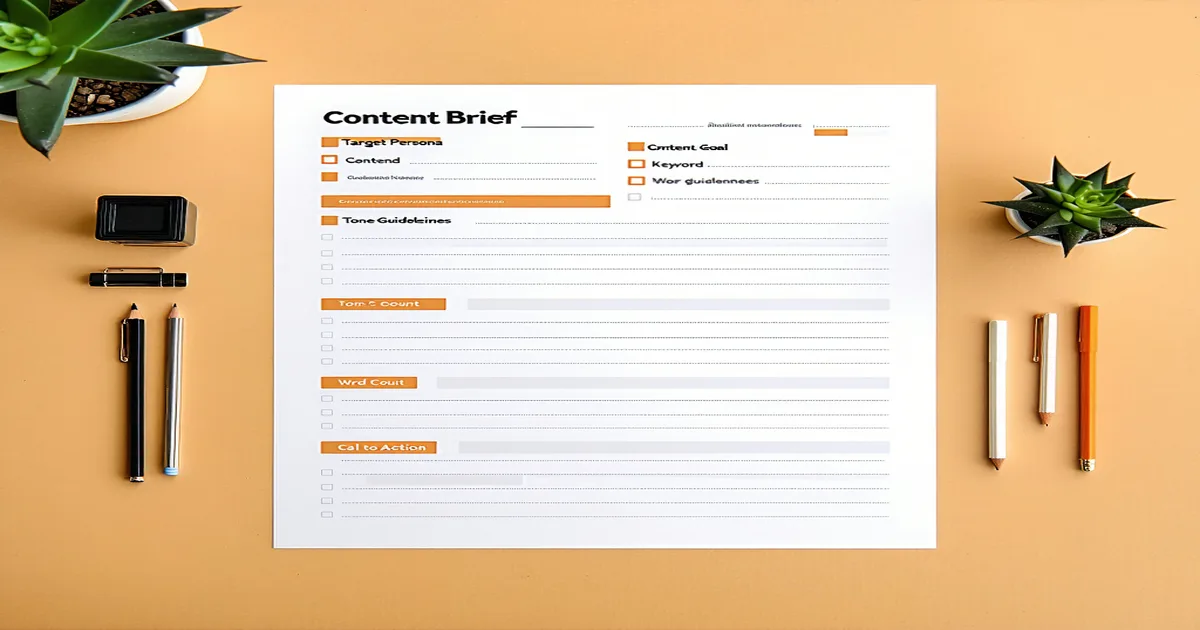
The Template That Produces Bad Writing
There is a content brief template doing rounds in B2B marketing that looks like this: title, target keyword, secondary keywords, word count, audience, tone, internal links to include, competitor articles to reference. If it's a more sophisticated version, maybe a notes field at the bottom.
That template produces competent SEO writing. It produces search-optimized mediocrity at a consistent, reliable pace. It is a content brief template in the sense that a Mad Libs is a story template: it has the right structural shape, but the writer filling in the fields is working without the information they actually need to produce something worth reading.
The gap is not the template's length or the number of fields. It's what the template treats as an afterthought — or omits entirely: the reader's specific mental state, the editorial position the piece is taking, the one thing the reader should believe after finishing, the voice constraints that make this piece unmistakably this brand rather than any brand.
This piece is about what a brief template actually needs to contain to produce writing that meets the spec on the first draft. The template structure is a secondary concern. Getting the fields right is the real work.
The Field That Changes Everything: Reader Mental State
Most brief templates have an "audience" or "persona" field that gets filled in with something like "VP Marketing" or "Head of Demand Gen at a mid-market SaaS company." That's a job description, not a reader state. A VP Marketing in Q1 evaluating their content program's annual budget is in a completely different mental state than a VP Marketing in Q3 who just had their organic traffic drop 35% and is presenting to the board next week.
The brief field that produces the highest-leverage writing improvement is this: What is this reader's emotional and operational state when they encounter this piece? Not their job title. Their situation. What has just happened that makes them receptive to this argument? What are they worried about? What are they trying to accomplish in the next 30 days?
A writer who knows the reader is anxious about board-level scrutiny writes a different piece than one who knows the reader is in an exploration mode browsing for new ideas. Both are "VP Marketing." The piece that addresses the anxious, board-pressured reader — specifically, with that framing front and center — converts at a different rate than the generic "VP Marketing" overview because the reader recognizes themselves in it.
The Position Field: What Does This Argue?
The second field that most brief templates either omit or treat too vaguely is the editorial position. "What is this piece arguing that someone could reasonably disagree with?"
This question deserves its own field, separate from the "topic" field. A brief that says topic: "B2B content briefs" and a brief that says position: "Most B2B content briefs fail because they omit the reader's mental state, and that omission is responsible for more first-draft misses than any writing quality problem" are doing fundamentally different things for the writer. The first tells the writer what subject area to write in. The second tells the writer what to argue.
The position field also functions as a content quality gate: if the content strategist can't fill in a specific, debatable position, the piece probably shouldn't be commissioned yet. "Thought leadership on content briefs" is a topic aspiration, not a content brief. "Most content brief templates are optimized for SEO, not for writer instruction, and that's why they consistently produce content that requires three revision rounds" is a brief.
Voice and Tone: The Difference Between Describable and Actionable
The voice section of most brief templates contains one of two things: a brand adjectives list ("direct, authoritative, approachable") or a tonal direction so vague it could describe any professional writing ("clear and engaging, not too formal"). Neither of those is actionable for a writer sitting down to write.
Actionable voice guidance in a brief looks like three things:
First, a format default for this piece: does it open with a problem statement or a counterintuitive claim? Does it use subheadings as directional sentences or as category labels? Does it close with a recommendation or leave the reader with a question?
Second, one or two "do not write like this" examples. The negative constraints are often more useful than the positive description. "Don't open with a definition" is clearer than "don't be too academic." "Avoid passive constructions in the lead paragraph" is more instructive than "be direct."
Third — and this is the highest-leverage addition to any brief template — two sentences from a recent on-brand piece that represent the voice correctly. Not a description of the voice. An example of it. A writer who has two sample sentences from the brand can calibrate their register in a way that no adjective list enables.
The Distribution Field Most Briefs Don't Have
Content that doesn't have a distribution plan attached to the brief tends to get published, get one or two pushes across owned channels, and then sit in the archive receiving only organic traffic. That's a reasonable outcome for a keyword-targeted SEO piece. It's a terrible outcome for a demand-gen article you spent five hours producing.
A brief template for demand-gen content should include a mandatory distribution section that specifies: which email segments receive this piece, whether it's going into a nurture sequence (and if so, which one), the LinkedIn post angle, the SDR outreach touchpoint if applicable, and the re-distribution date six months out to freshen the content. This is an ops field, not a writing field — but putting it in the brief forces the distribution decision to happen before production, not after, when the bandwidth to think about it is gone.
We are not saying every piece needs a six-channel distribution plan. We are saying that a brief that doesn't specify distribution for a piece intended to generate MQLs has set up the production workflow to fail at the moment that matters most: after the writing is done.
Template Variants by Content Type
One brief template for all content types is the content ops equivalent of using one wrench for every bolt size. The fields that matter for a thought leadership article are substantially different from the fields that matter for a sales enablement one-pager or an email nurture sequence.
A thought leadership article brief needs: reader mental state, editorial position, argument structure outline, voice examples, supporting evidence available, distribution plan. A sales enablement brief needs: deal moment (post-demo? cold reach? decision stage?), buyer's current objection, one proof point to lead with, the rep's most common follow-up question this piece should preempt, format constraints (single side? two pages?). An email nurture brief needs: enrollment trigger and what it indicates about reader state, position in sequence (which email number?), value-to-ask ratio for this email, the single CTA, what the next email in the sequence will do.
Building three brief templates — one per primary content type — takes an afternoon. It pays back in fewer revision rounds immediately. The teams that see the biggest brief-quality improvement typically start by building the thought leadership template (because that's where revision cycles are longest and most expensive) and add the others as volume in those formats increases.
The Living Brief vs. the Sent Brief
One underutilized practice in high-volume B2B content programs is the brief review meeting — a 15-minute standing call where the content manager walks through two or three upcoming briefs with a product marketer and a senior writer before they're sent. The value is not that the brief gets perfected in the meeting. The value is that the act of presenting the brief out loud exposes the vague fields and unresolved questions that look fine in writing but fall apart when someone asks "what do you mean by that?"
A brief that hasn't been walked through out loud is a brief that has never been stress-tested. The writer who receives it will do the stress testing — and they'll do it in the revision cycle, which is a much more expensive place to find out that the position wasn't clear. The 15-minute meeting is the cheaper alternative. Teams that run it consistently report fewer first-draft misses and a brief quality that improves over time because the patterns of vague fields become visible and fixable.