The Confusion That Costs Marketing Teams Quarters
In B2B marketing, few terms get blurred together more casually — and with more expensive consequences — than content strategy and content operations. Most teams either conflate them entirely or treat one as a subset of the other. The result is predictable: either a well-designed content program that never ships reliably, or a production machine grinding out volume with no clear purpose.
Getting this distinction right is not academic. It determines how you hire, what metrics you run toward, and where your bottlenecks actually live when the program stalls.
What Content Strategy Is (and Isn't)
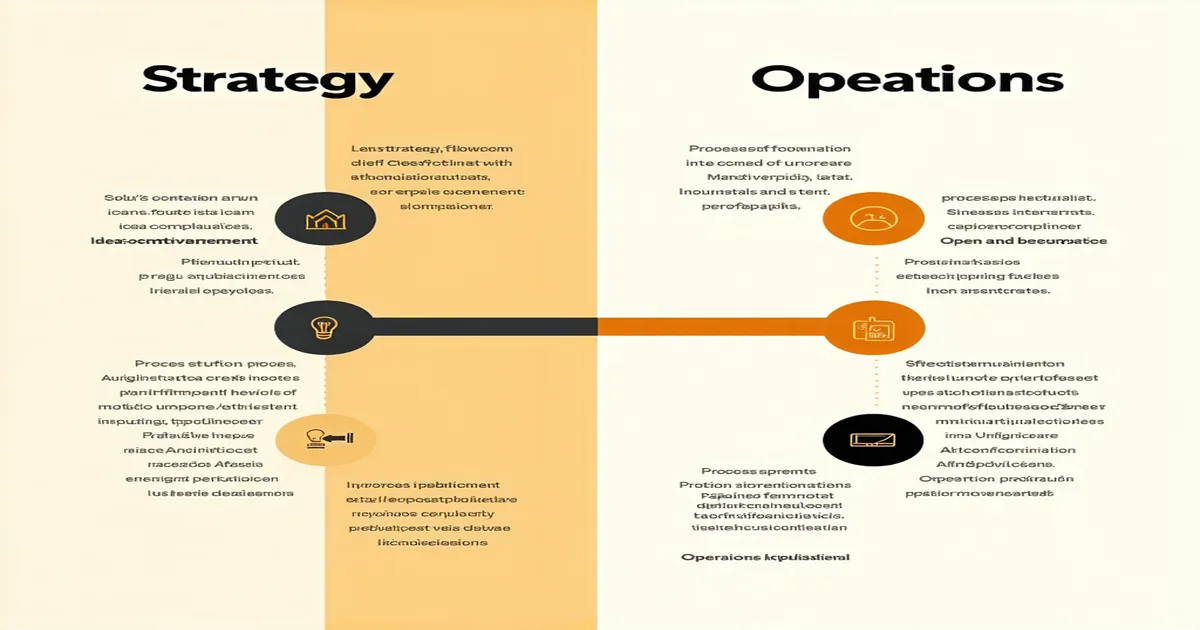
Content strategy is the set of decisions that determine what content you make, for whom, and why. It answers questions like: which topics build credibility in our ICP's mind? Which funnel stages are currently underserved? What content angles differentiate us from the three competitors our buyers are also reading? What claims does our brand actually have the authority to make?
Good content strategy produces documents that look like: a pillar content map organized by ICP segment and funnel stage, a topic authority plan identifying the three to five subjects where you intend to build search and thought leadership position over 12 months, and a voice-positioning document that articulates what your content will not do as clearly as what it will.
Content strategy does not produce a content calendar. That's operations. Strategy produces the decision framework that makes the calendar's choices defensible.
What Content Ops Is (and Isn't)
Content operations is the system that takes strategy decisions and turns them into published content, reliably, at a defined quality level, without requiring heroic individual effort each time.
A mature content ops function owns: the brief-to-publish workflow (who does what, in what order, using what tools), the brief template and briefing standards, the review and approval system, the publication and distribution checklist, the freelancer or agency management process, and the performance data collection that feeds back into strategy.
Notice that none of those activities involve deciding what to write about. That's strategy's domain. Ops takes the decisions as inputs and builds the machine that produces outputs.
Content ops also does not own content quality in the abstract. It owns the conditions for quality: clear briefs, appropriate review steps, a defined voice standard, a realistic production schedule. If those conditions are met and quality is still poor, that's a talent issue, not an ops issue.
Why Teams Underinvest in Ops (And What Breaks)
The funding pattern in B2B content teams tends to follow a predictable sequence: hire a content strategist, get a nice editorial calendar and a topic plan, then wonder why the publishing schedule keeps slipping and why the content coming back from writers rarely matches the brief. The answer, almost always, is that ops was never built.
Strategy without ops produces what might be called a vision board state: a clear direction with no reliable mechanism to move toward it. The content calendar gets built. The briefs are ambitious. The production falls apart at execution because no one owns the workflow system — everyone improvises, every time.
The typical symptoms: briefs written in Slack threads, feedback given verbally and then forgotten, writers unsure whether they're serving version two or version three of the brief, publication dates that slip by a week every cycle, content that never gets updated after the first month. These are operations failures, not strategy failures.
The Opposite Problem: Ops Without Strategy
The reverse failure is less common but equally damaging. An operations-heavy team that lacks clear strategy tends to optimize production for the wrong things. They get very good at shipping content efficiently — and the content gradually drifts toward volume metrics and keyword targets rather than building genuine authority or serving the sales cycle.
We are not saying that operational efficiency is a bad thing — it's essential at any meaningful content volume. We are saying that ops without strategy is a treadmill: the team is working hard, the output volume looks impressive, and the program isn't moving the pipeline numbers because no one stopped to decide which topics actually matter to buyers at each stage of the funnel.
The Handoff Points That Break Down
The failure modes between strategy and ops almost always appear at three specific handoff points:
Strategy to brief. The content map says "write about data security for CTOs." The brief says "topic: data security, audience: CTOs, tone: authoritative." Everything the strategy knew about the CTO's specific anxiety — that they're evaluating their current vendor and worried about compliance gaps before an audit — never made it into the brief. The writer has no access to the strategic context, so they write a generic data security overview that serves no one.
Brief to writer. Even a detailed brief is ineffective if no one checks that the writer understood it. In teams shipping more than 10 pieces per month, a brief alignment call — 15 minutes before writing starts — catches misunderstandings before they become revision cycles. Most teams skip it to save time and spend three times as long on revisions.
Published content back to strategy. Content that performed well, content that the sales team actually uses, content that drove SQL activity — those data points should feed directly back into the strategy's next planning cycle. In teams where ops and strategy aren't connected, that loop never closes. The strategy team sets direction in a vacuum, the ops team ships content, and no one updates the plan based on what actually worked.
Building the Two Functions in Practice
For an early-stage B2B company — think a PLG SaaS team at $5M ARR with two marketing hires — the practical answer is that one person often carries both functions. That's workable, but only if that person is explicit about which mode they're in at any given moment. "Strategy week" produces the topic plan and brief templates. "Ops week" executes the production schedule. Mixing them continuously tends to produce mediocre performance in both.
As the team grows, the split becomes cleaner. The content strategist owns the editorial roadmap, the ICP and persona documentation, and the competitive positioning of the content program. The content ops manager owns the production calendar, the brief workflow, the vendor relationships, and the distribution checklist. They meet weekly to make sure strategy decisions are actually making it into production decisions.
The test for whether you've achieved this balance: can someone on the ops side answer "why are we writing this piece?" and someone on the strategy side answer "how does this piece get from brief to published?" If either team can't answer the other's question, the handoff is broken.
Fix the handoff. The content improves on both sides of it.