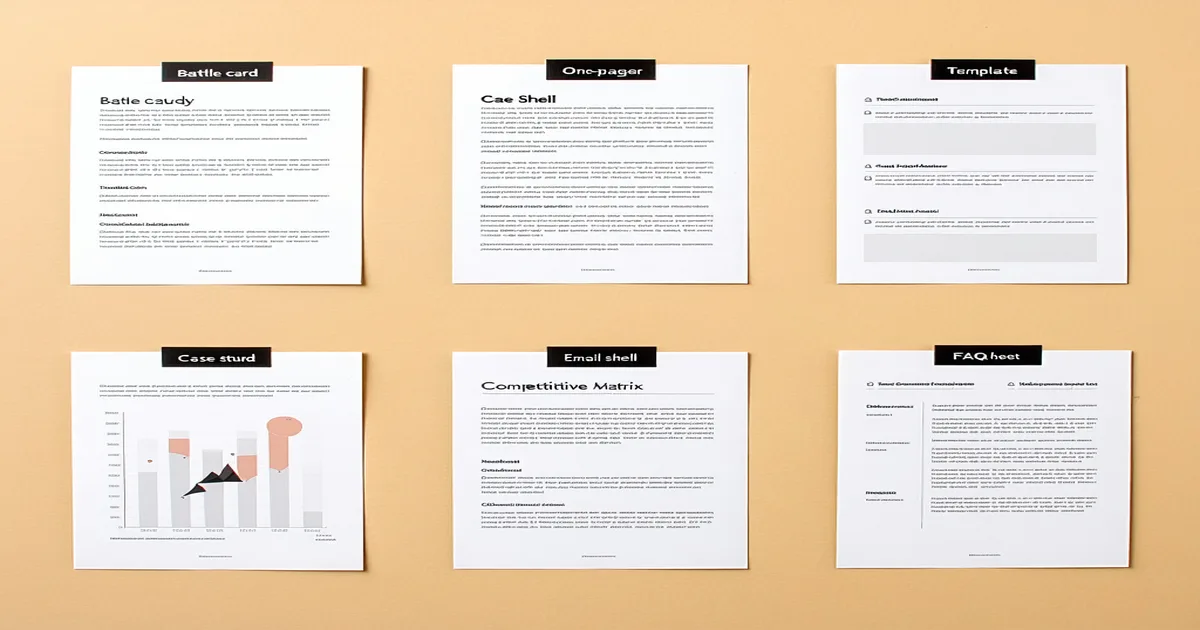
The Asset Library Problem
Most B2B sales teams have an asset library. Most of those libraries contain: a slide deck from last year that's 60% out of date, a case study PDF designed for a customer segment that no longer exists, a one-pager that the marketing team loves and the sales team has never sent once, and approximately fourteen variations of a company overview that no rep can find when they need it.
Sales enablement content fails in two ways. Either marketing produces assets that reps don't use because they don't fit the actual deal context — too generic, too product-forward, wrong format for where the buyer is in the conversation. Or the right asset types don't exist at all, so reps improvise with whatever's available, and what buyers receive is inconsistent, off-brand, and sometimes inaccurate.
The six assets in this piece are not a comprehensive list of every document a sales team might ever need. They are the foundation layer: the assets that cover the majority of common deal moments and that, if done well, reps will actually reach for. This is not a guarantee — nothing about asset creation guarantees rep adoption. But getting these six right dramatically reduces the gap between what marketing produces and what sales uses.
Asset 1: The Problem-First One-Pager
The standard B2B one-pager opens with the company overview, lists features in three columns, and ends with a logo cloud. Reps hate sending it because they know buyers don't read it. The buyer's question in the first half of a deal is not "what does this product do?" — it's "does this company understand my problem?"
A problem-first one-pager leads with the buyer's pain, framed specifically enough that the right ICP recognizes themselves in it. The product appears in context — here's how this problem gets solved — not as the opening statement. Format: single side, no more than three sections, no feature lists. The test: could a buyer who has never heard of your company read this and feel like the writer has been watching their team for six months?
Asset 2: The Battle Card
A battle card is a competitive positioning document used by reps during objection handling, not a document sent to buyers. That distinction matters. Battle cards can be direct and candid in a way that external content cannot — they're internal tools that help reps navigate competitive conversations with accuracy and confidence.
An effective battle card for each primary competitor includes: the three most common objections in competitive deals, the factual response to each, the competitor's known weaknesses (and how to surface them without disparaging), and the deal scenarios where you tend to win or lose and why. Battle cards that are too long don't get used. One page per competitor. Update them quarterly or when you lose a competitive deal you should have won.
Asset 3: The Executive Summary
At some point in a B2B deal, an economic buyer who wasn't in any of the discovery or demo conversations needs to get up to speed fast. This is the moment the deal either stalls or advances. If the champion has to verbally brief the CFO, the framing will be inconsistent and important context will get dropped. An executive summary gives the champion a professionally framed document that does the briefing for them.
The executive summary is different from the one-pager: it assumes the buyer is already in consideration, not at the problem-awareness stage. It summarizes the problem as scoped in discovery, the proposed approach, the expected outcome, and the investment. Two pages maximum. Ideally customized by deal — at minimum, the problem description should reflect the actual pain points discussed in discovery rather than generic ICP language.
Asset 4: The ROI / Business Case Template
Economic buyers need to justify the purchase decision internally. Reps who help them build that justification close deals faster than reps who leave it to the buyer to figure out. An ROI template is not a vendor-produced spreadsheet with numbers that make the vendor look good — buyers don't trust those. It's a framework that helps the buyer plug in their own numbers and see the calculation in terms they'll defend to their CFO.
The template should include: a section for current-state cost inputs (time spent, tools currently in use, headcount cost per function), a formula for calculating the efficiency gain or cost displacement, and a section for the buyer to fill in their own risk adjustment. The vendor's job is to provide the structure, not pre-fill it with favorable assumptions.
We are not saying every deal requires a formal ROI analysis — many smaller transactions don't justify the overhead. We are saying that when deals stall at the economic buyer stage and the champion reports "they need to see the numbers," a blank Excel file and good intentions is not an answer.
Asset 5: The Technical Integration Brief
B2B SaaS deals that involve IT or engineering stakeholders often stall when the technical review starts because the evaluating team doesn't have a clear picture of what integration actually involves. A technical brief answers the questions that show up in those conversations: what APIs does the platform expose, what does the standard integration pattern look like, what are the data security controls, what does implementation typically take?
This is not a spec document or a developer guide — it's a one-to-two-page summary designed to give a senior engineer or IT director enough information to decide whether a more detailed evaluation is worth pursuing. The format matters: structured, scannable, factually precise. Technical stakeholders who receive marketing fluff in response to technical questions lose confidence in the vendor immediately.
Asset 6: The Post-Demo Leave-Behind
After a product demo, the buyer's next 48 hours are when recency bias and deal momentum are highest. Most reps follow up with "great to connect" email and a link to the website. The reps who close more often send something the buyer can share internally — a crisp summary of what was demonstrated, the specific use cases discussed, and the proposed next step.
This isn't a formal document. It's a one-pager built from a modular template: the buyer's stated problem (one sentence), the three things demonstrated in the session, a customized next-step proposal. It takes a rep ten minutes to complete if the template is built correctly and they've taken notes during the call. The impact on deal velocity is disproportionate to the effort.
The Maintenance Problem
The six assets above only produce value if they're current. A one-pager that refers to a product capability that has since changed, or a battle card with a competitor's pricing that's two years out of date, is worse than nothing — it erodes trust the moment a prospect fact-checks it. Building the assets is the easy part. Building the update cadence is the operational discipline that separates an effective sales enablement program from a library of expensive liabilities.
Assign ownership of each asset type to a specific person, with a defined review trigger: after each product release, after each major competitive deal lost, quarterly for everything else. The review doesn't have to be a full rewrite — often it's updating three fields and changing a date. What it can't be is no one's job until someone sends the wrong version to a prospect and a deal dies from it.